
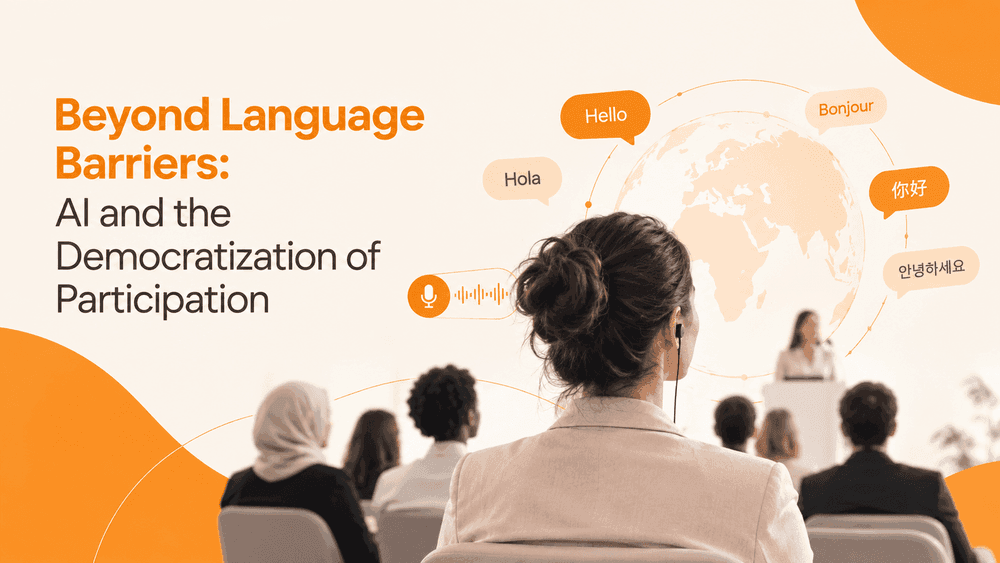
Beyond Language Barriers: AI and the Democratization of Participation
AI translation is changing multilingual conferences, not just by helping people understand, but by giving more attendees the confidence and ability to participate. Discover how AI translation is breaking language barriers at international conferences and turning passive attendees into active participants.
A three-day international conference covering four languages with traditional on-site interpreters typically costs between $50,000 and $120,000, once you factor in interpreter teams, soundproof booths, and equipment. Cover ten languages with AI translation instead, and the same event can run under $5,000. That's a 10 to 50x cost gap, and it's before you even count the practical ceiling: most booth-based interpretation setups max out around six languages before organizers start relying on relay interpretation, guessing at meaning through a third language.
For organizers planning a genuinely international conference, this isn't a budgeting detail. It's the difference between who gets to follow the conversation and who gets left outside it.
Ignore this gap, and the cost doesn't show up as a line item. It shows up in a session where half the room understands the keynote and the other half nods along, unable to ask a question, unable to challenge a point, unable to be part of the discussion they traveled to attend. They're present, but they're not participating.
This blog covers what's actually changed in AI translation, a practical framework for integrating it into an international conference, a real scenario showing the shift, and the mistakes that undermine it even when the technology is in place.
What AI Translation Actually Means for Participation In International Conferences
Language participation AI refers to translation technology designed around enabling active engagement, not just comprehension. It focuses on getting attendees to the point where they can ask questions, respond, and contribute in real time, rather than simply follow along with what's being said. Traditional interpretation decodes words but language participation AI decodes meaning, tone, and intent, in real time, and returns it to the listener in a form that lets them actually respond, not just follow along.
This distinction matters because comprehension and participation are not the same outcome. An attendee who understands a keynote through a slightly delayed, flattened translation still can't raise their hand with confidence when the moment to ask a question arrives. The gap between hearing and responding is where engagement quietly dies at multilingual events.
Real inclusion isn't measured by how many languages appear on the program. It's measured by how many voices get heard from the floor.
AI-driven language accessibility closes that gap for a structural reason: scale. Human interpretation is capped by headcount. Two interpreters per language, rotating every 20 to 30 minutes under AIIC standard, means every additional language multiplies your team, your booths, and your budget. AI translation doesn't scale that way. Adding a tenth language costs marginally more than adding a third.
The technology has also crossed a threshold that matters specifically for conferences. Earlier machine translation stripped tone and rendered formal speech as flat, sometimes awkward text. Current AI translation carries register, hesitation, and emphasis, the difference between a diplomatic hedge and a firm commitment, which matters enormously in rooms where policy or funding gets discussed.
From Passive Attendees to Active Voices
Consider the pattern we've seen firsthand at gatherings like the Global Pastoralist Gathering and Conference in Mongolia and side events at COP17, where attendees came from dozens of countries and no single shared language covered the room, and where Omnio was the AI translation layer running in the background.
Before AI translation: A handful of interpreters covered the dominant languages of the organizing bodies. Attendees from smaller language communities, herders, community leaders, regional delegates, followed sessions through informal peer translation or stayed quiet during open floor discussions, even when they had direct, firsthand expertise to contribute.
After deploying Omnio's real-time AI translation: The same attendees who previously sat through sessions passively began asking questions directly, in their own language, without waiting for a volunteer translator or a break in the schedule. Breaking global language boundaries wasn't a slogan for these events, it was the difference between a delegate observing a policy discussion and a delegate shaping it, and it happened because Omnio was picking up the audio, translating tone and intent, and returning it in real time to every headset and screen in the room.
This is the shift Omnio is built to create as a zero-barrier communication tool: not just wider comprehension, but the confidence to speak up in a room where, historically, only a few languages carried authority. Omnio processes spoken audio in real time and returns both translated audio and live captions in the listener's language, preserving tone and intent rather than producing a flat, literal conversion of the original words.
The Floor Belongs to Everyone in the Room
Breaking global language boundaries isn't an accessibility add-on anymore. For any conference that calls itself international, it's the infrastructure that decides whether the event lives up to that word.
Organizers who get this right aren't remembered for a smooth agenda. They're remembered as the event where a delegate who normally sits in the back row stood up and asked the question that changed the discussion. At the events where we've deployed it, Omnio has consistently been the reason that delegates could stand up in the first place.
Omnio was built specifically for this problem: real-time, tone-aware AI translation for conferences, gatherings, and summits where the room is genuinely global and no single language should decide who gets heard. It's already running at pastoralist gatherings and COP side events, turning passive attendees into active participants without adding interpreter booths or per-language costs to your budget.
Planning a multilingual conference and want to see what Omnio looks like in the room?
Visit our website to see how Omnio's real-time translation can open the floor to every attendee at your next event, not just the ones who share the organizers' language.
Beyond Language Barriers: AI and the Democratization of Participation
AI translation is changing multilingual conferences, not just by helping people understand, but by giving more attendees the confidence and ability to participate. Discover how AI translation is breaking language barriers at international conferences and turning passive attendees into active participants.