
Empty Classrooms, Lost Futures: The Teacher Shortage Crisis in Nepal
UNESCO warns that missing teachers lead to larger class sizes and overburdened educators, eroding learning outcomes. Europe, Asia, or Nepal, the picture is consistent: we’re losing teachers faster than we’re training them. Add to this the fact that so many young people now pursue technical, medical, or overseas opportunities, and it’s clear the teaching profession often takes a back seat.
I was surprised to read a news item on Facebook with a viral headline: a small private school in Kailali Province offered a one-lakh-rupee monthly salary, plus free lodging and meals, to lure a math teacher. The school’s principal later confirmed it was no joke. In a country where many teachers earn poverty-level pay, such an offer seemed unbelievable. Yet it underlines a hard truth: Nepal is desperate for qualified teachers, especially in critical subjects like math and science. As one principal put it, only by “offering respectful facilities” could they hope to attract the skilled educators their students deserve.
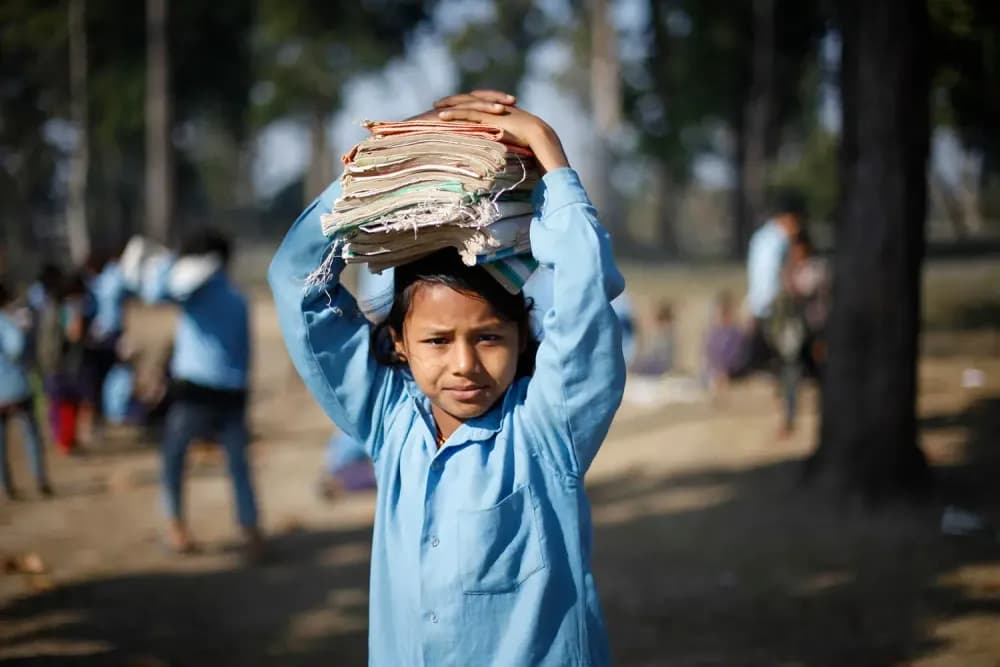
These Nepali schoolchildren sit ready to learn, but all too often the classes are not taken due to the unavailability of the teachers. Across rural Nepal, repeated vacancy announcements for math, science, or English teachers are met with silence[1][2]. In Gulmi district, for example, local officials placed 15 separate ads over months for a secondary-level math teacher, and not a single qualified candidate applied[1]. Another hill school tried three times to hire a science teacher, with the same result[2]. When no new teachers come, schools resort to using lower-grade instructors to cover upper classes, or freezing federal grants for those subjects. As a Gulmi education officer warns, this chronic shortage has already caused “a visible decline in educational quality”[3]. In short, students are falling through the cracks whenever the classroom is left without a trained instructor.
- Gulmi (Lumbini Province): 15 announcements for a higher-secondary math teacher, 0 applicants[1]. Lower-secondary teachers now “run” higher classes despite full schedules[4].
- Malika Rural Municipality (Kailali): 3 ads for a science teacher, 0 applicants[5]. Lower-grade teachers are forced to cover higher-grade science[5].
- Khadgakot, Kaligandaki (Gandaki Province): 4 ads for a math teacher, 0 applicants[6]. School resorts to assigning any available teacher, blurring grade levels.
- Rajapur, Bardiya (Lumbini Province): Repeated ads for math and English teachers only occasionally yield a candidate; science teacher posts stay empty[7]. Many science graduates lack a teaching license, and those with licenses shun rural posts.
Each dot on this national map of teacher shortage is a school forced to improvise. Classroom corners once meant for science experiments or math drills now sit idle, while students drift to private tuition centers to learn basics. In Karnali, Nepal’s largest, poorest province, the situation is stark. Nearly 5,000 teaching posts (grades 1–10) are currently vacant[8]. An education officer there laments that “almost every school fails to complete courses of at least one subject,” and that shortfall directly fuels weak exam results[9]. In practical terms, without a math or science teacher, entire chapters are skipped, and children enter crucial exams ill-prepared.
This ripple effect hits hardest in STEM subjects. When a school can’t hire a math teacher, math class might be skipped entirely or taught by an under-qualified instructor. Not surprisingly, student performance in math and science is plummeting. In one district alone, 2,400 out of 9,000 students failed the Secondary Education Exam (Grade 10) in mathematics last year, nearly two-thirds of all failures[10]. In Karnali, SEE (Grade 10) failure rates in many schools exceed 50%[11]. These students are bright, but a broken system is starving them of learning. As a Karnali headmaster grimly notes, “Without teachers, the syllabus is never completed, and students are compelled to sit the SEE relying entirely on private tuition classes.”[12]
What does all this mean for education quality? In a word: decline.
UNESCO warns that missing teachers lead to larger class sizes and overburdened educators, eroding learning outcomes (more global context below)[13]. In Nepal’s case, teachers cite a “visible decline in educational quality” when core subjects go untaught[3]. Younger and rural students are at a disadvantage: if they miss foundational math in Class 9, they can never catch up for the SEE exam. The curriculum assumes all chapters are covered; when they’re not, exam performance tanks. In effect, teacher absence matters — it translates directly into a generation with weaker STEM skills.
Yet this teacher-shortage story is not limited to Nepal’s hills. It is a global crisis. A new UNESCO report projects that by 2030, the world will need 44 million new primary and secondary teachers[14]. Much of that demand is at the secondary level: about seven out of ten of those 44 million will be for higher grades[14]. The reasons are familiar worldwide: enrollment growth in some regions, retirement waves in others, and most critically, sky-high attrition. In fact, globally, teacher attrition has skyrocketed; the share of primary teachers leaving the profession roughly doubled from 4.6% in 2015 to over 9% in 2022[15]. An expert notes that 58% of the projected 44 million shortfall is due to teachers quitting, not just population growth[16]. Even in wealthy nations, attracting and keeping teachers has become a challenge: in OECD countries, low pay, heavy workloads, and better opportunities elsewhere push many away[17][18]. Unsurprisingly, vacancies are hardest to fill in remote or disadvantaged areas[17], the same pattern we see in Nepal’s Karnali and Gulmi.
Europe, Asia, or Nepal, the picture is consistent: we’re losing teachers faster than we’re training them. Add to this the fact that so many young people now pursue technical, medical, or overseas opportunities, and it’s clear the teaching profession often takes a back seat. One Nepali education officer bluntly explains that after science or engineering degrees, “very few want to pursue a teaching career. These are technical subjects, and the teaching profession simply doesn’t attract enough candidates.”[19].
It’s worth asking: Why not?
Globally, policymakers point to incentive structures. The UN High-Level Panel on the teaching profession emphasizes that without competitive salaries and good working conditions, teaching loses its allure. In Nepal, the contrast is stark. A union leader recently pointed out that some teachers earn as little as Rs. 8,000 per month (about USD 60)[20]. At that rate, “nobody wants to be a teacher”[20], he says. Imagine that: one lakh rupees a month to make the job attractive, when official pay might be one-hundredth of that. No wonder young graduates compare the remuneration and head elsewhere. The working conditions don’t help either: remote postings, lack of professional development, and the daunting challenge of large, under-resourced classes make teaching a hard sell.
So what questions must we ask now? If we care about Nepal’s future, we have to wonder why this gap persists.
Education unions and international panels stress that this isn’t just a Nepal issue, it’s a symptom of how society values (or fails to value) teachers. Perhaps we have crafted a system where the best and brightest can earn far more outside the classroom, leaving schools with the leftover talent. Our classrooms suffer as a result: the well-funded, large science labs sit idle, math exercises go unchecked, and students lose faith when classes go unfilled.
As an educator and researcher, I will continue to explore these hard truths. We need to turn this conversation inward. Why have we let teaching become unattractive? How can we rebuild respect and incentives for educators, so that our smartest graduates consider standing at the blackboard instead of leaving for other fields? These are questions we must face as a society. I plan to write more on this topic. If you have experiences from Nepali schools, data on teacher shortages, or research on how communities worldwide have tackled this issue, please share. Only by bringing facts and stories together can we hope to answer: Why are our best talents running from the classroom, and what can we do to bring them back?
References
- [1] [2] [3] [4] [5] [6] [7] [10] [19] Subject teachers shortage hits rural schools https://kathmandupost.com/national/2025/08/26/subject-teachers-shortage-hits-rural-schools
- [8] [9] [12] Shortage of subject teachers hits Karnali schools, forcing SEE students to rely on private tuition https://kathmandupost.com/national/2025/12/20/shortage-of-subject-teachers-hits-karnali-schools-forcing-see-students-to-rely-on-private-tuition
- [11] Shortage of subject teachers hits Karnali schools, forcing SEE students to rely on private tuition — NePulse https://nepalinews.sanjayasubedi.com.np/news/88464/
- [13] [14] [15] Global report on teachers: What you need to know | UNESCO https://www.unesco.org/en/articles/global-report-teachers-what-you-need-know
- [16] What Global Trends Can Teach Us About Teacher Retention https://www.ascd.org/el/articles/what-global-trends-can-teach-us-about-teacher-retention
- [17] How severe are teacher shortages across countries?: Education at a Glance 2025 | OECD https://www.oecd.org/en/publications/2025/09/education-at-a-glance-2025_c58fc9ae/full-report/how-severe-are-teacher-shortages-across-countries_781f4a97.html
- [18] The United Nations Says Teacher Shortages Are a Global Problem https://www.edweek.org/leadership/the-united-nations-says-teacher-shortages-are-a-global-problem/2025/09
- [20] [21] Addressing the teacher shortage crisis in Nepal: A call for action https://www.ei-ie.org/en/item/28758:addressing-the-teacher-shortage-crisis-in-nepal-a-call-for-action
Empty Classrooms, Lost Futures: The Teacher Shortage Crisis in Nepal
UNESCO warns that missing teachers lead to larger class sizes and overburdened educators, eroding learning outcomes. Europe, Asia, or Nepal, the picture is consistent: we’re losing teachers faster than we’re training them. Add to this the fact that so many young people now pursue technical, medical, or overseas opportunities, and it’s clear the teaching profession often takes a back seat.