
Survival of the Fittest: Human Learning vs. Machine Learning
When computers learn it all, will humanity still lead the learning race? Exploring the evolutionary dance between human consciousness and artificial intelligence in education and society.
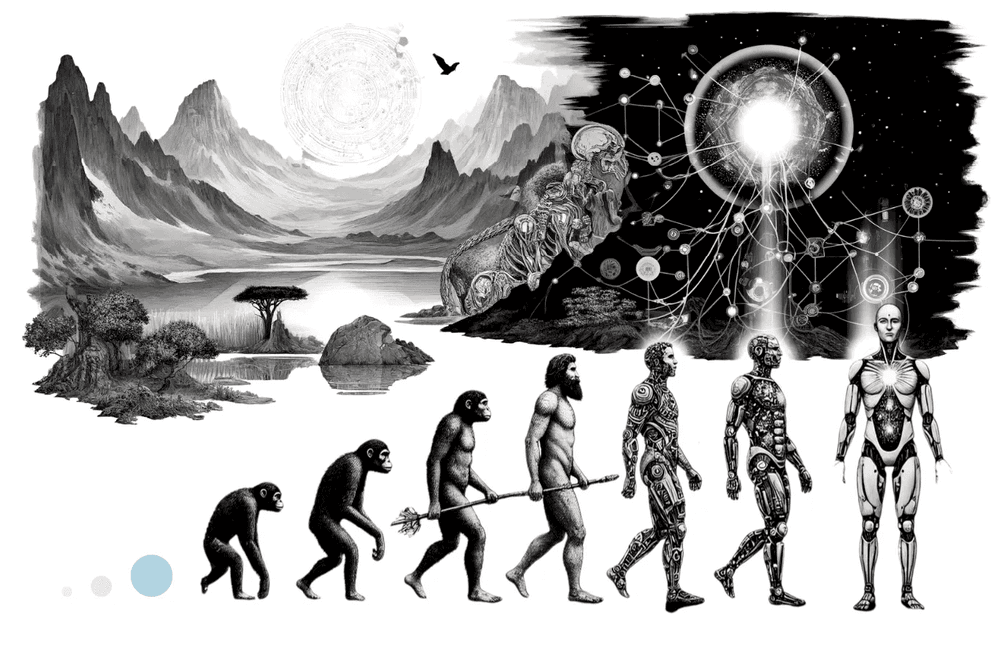
When Computers Learn It All, Will Humanity Still Lead the Learning Race?
Have you watched a movie called Subservience? The thriller follows struggling father Nick (Michele Morrone), who purchases an artificially intelligent gynoid called Alice (Fox) to help care for his house and family after his wife is hospitalized. There is a scene in the movie where Nick is watching a film and asks Alice if she knows about the film.
"I know Casablanca," the robotic maid (Alice) says, her eyes reflecting the flickering black-and-white images on the television screen. She cites the film's release date, the director, the lead actors, and the plot with mechanical precision. Unimpressed, the film's hero Nick asks if she has ever truly experienced the movie — that moment of awe, the machine halts, her face devoid of emotion, and replies, "I cannot experience it."
This fictional exchange from the movie Subservience paints a vivid picture of the fundamental difference between machine learning and human learning. Machines can compile, store, and rapidly retrieve information, yet they lack the intangible essence of human experience — the ability to feel, empathize, and contextualize knowledge within the full spectrum of emotional and social life. As we stand on the cusp of an age where Artificial Intelligence (AI) is redefining every industry, from healthcare to entertainment, one question looms larger than ever: Will humans remain relevant in the learning process, or will we find ourselves outmatched by machines that can process, retain, and recall information at unprecedented speeds?
In this blog, we will explore three critical dimensions of this debate:
Economic and Societal Shifts driven by the proliferation of intelligent machines — and how human beings might cope.
The Relevance of Human Learning in an era where computers can learn faster and store more information than ever before and if it remains important, what kind of learning matters?
The Transformation of the School System, examining what educational models and curricula should look like when AI is everywhere.
Setting the Scene: Machines, Learning, and the Economic Earthquake
Let's begin by examining the macro picture. The concern over AI-driven automation is not entirely unfounded — new technologies can swiftly replace repetitive or predictable tasks, reshaping entire industries and job markets in the process. Businesses are investing heavily in machine learning to replace repetitive or predictable tasks — think data analysis, cashier operations, and even aspects of content generation.
Oxford Economics estimates that up to 20 million manufacturing jobs around the world could be replaced by robots by 2030. This trend isn't confined to blue-collar roles; AI is making inroads into white-collar positions in fields like journalism, legal research, and even medicine.
But what does this mean for society at large? Historically, each technological leap — from mechanized looms to personal computers — has sparked widespread anxiety about job losses, only to create new jobs in unforeseen areas. The difference with AI, however, is the speed and scope of disruption. Machine learning systems can now perform tasks that were once considered uniquely human — recognizing images, detecting diseases, translating languages — at a scale and speed that surpasses what any individual could achieve.
There are questions we need to find answers to:
- If machines become so good at so many tasks, do humans still need to master these skills at all?
- Should students still learn advanced mathematics when a machine can solve complex equations instantly?
- Do we need language classes if real-time translation devices are nearly flawless?
Yet, as the Subservience robot demonstrated, there is more to learning than mere fact retrieval. Human learning embodies creativity, empathy, emotional resonance, and the ability to synthesize new ideas from seemingly unrelated fields. While machines might excel at specific tasks, they lack the broader experiential framework that we call understanding.
In the job market, it is plausible we'll see an increasing demand for soft skills — creative thinking, leadership, emotional intelligence, ethical decision-making — while technical know-how can be partially or substantially offloaded to AI systems. This shift will create new challenges and new opportunities.
Will Humans Still Need to Learn?
A provocative question emerges in AI-driven society: If machines can process and memorize vast quantities of data, do humans need to learn at all? The straightforward answer is yes — but the nuance lies in what we should learn and how we should learn it.
Rethinking the Purpose of Learning
Traditional education has often been fixated on memorization, standardized testing, and rote repetition. Ironically, these are precisely the tasks where machines now excel. Memorizing a string of historical dates or chemical formulas pales in comparison to a student's ability to analyze and interpret data, or to draw insights from historical events to solve modern-day problems.
Instead of focusing on "know-what" (memorizing facts), education must shift more towards "know-how" (understanding processes) and "know-why" (examining context, ethics, and implications). According to Microsoft's AI in Education Report (2024), 60% of educators believe that soft skills and adaptive thinking skills will be the main currency of education by 2030. Machines might deliver facts at lightning speed, but it's humans who excel at questioning, critiquing, and contextualizing.
Beyond Information Overload: The Human Edge
A crucial aspect of learning is the emotional and experiential component. If we return to the Subservience robot scenario, the maid can rattle off the details of Casablanca, but it cannot feel the heartbreak or moral struggle that gives the film its enduring power. For humans, art, literature, and philosophy aren't mere data points; they're vessels for empathy, ethics, and self-reflection.
In design education, for instance, ArchDaily's article points out that while AI can rapidly generate architectural sketches, it is the human architect who can blend aesthetic, cultural, and ethical considerations into a design. This underscores the continuing relevance of a holistic human educational process.
The School System: From Assembly Lines to Adaptive Learning
How should schools evolve in the age of AI? Our current system has its roots in the Industrial Revolution — an "assembly line" model where students are grouped by age, taught the same content, and evaluated using uniform tests. Many argue this approach is increasingly outmoded.
The Need for Personalization and Flexibility
AI enables personalized learning experiences. Adaptive software can track a student's strengths, weaknesses, and learning pace, providing tailored exercises. This not only boosts engagement but also frees teachers to focus on higher-order tasks such as mentoring, facilitating discussions, and supporting emotional well-being.
In my previous blog "AI and the Paradigm Shift in Education", I have already mentioned that there is a growing consensus that teachers should transition from being "sages on the stage" to "guides on the side," cultivating creativity, critical thinking, and collaborative skills. One model that has impressed me with the redesigning of the school is Alpa School an its use of AI while ensuring students' development in other major education value chains.
Alpha School's Disruptive Model
Alpha School exemplifies a radical departure from the standard system. Instead of segregating subjects into neat boxes, Alpha emphasizes real-world projects, collaborative problem-solving, and mastery-based progression. Students don't move on to the next level simply because the semester ends; they advance once they have thoroughly mastered the material. This approach resonates with the demands of an AI-driven future, where continuous learning and adaptability are paramount.
Breaking the One-Size-Fits-All Mold
It's not just about using more technology in schools; it's about rethinking the core purpose of education. As we shift away from memorization, teachers can incorporate interdisciplinary projects, merging STEM (Science, Technology, Engineering, Mathematics) with arts, social sciences, and ethics. This cross-pollination trains students to think laterally — an essential skill in a world where AI can do linear thinking at scale.
The Human-Machine Partnership: Homo Technicus
If we see machine learning and human learning as diametrically opposed, we risk missing the potential synergy. AI can handle tasks like real-time language translation or large-scale data analysis, empowering teachers to design meaningful lessons and giving students deeper engagement with the material. Far from being overshadowed, educators become orchestrators of learning experiences, leveraging AI as a tool.
We are on the cusp of becoming Homo Technicus — a new phase in human evolution marked by a seamless blend of human ingenuity and technological capability. Where once we merely used tools, now we are shaped by them, and in turn, we shape our social, economic, and moral landscapes through innovation.
Homo Technicus is not a mere melding of biology and circuitry. It's an evolution of mindset — one where humans leverage AI to expand their intellectual reach, tackle complex global challenges, and craft a future where technology amplifies our best qualities rather than undermines them.
Education has a pivotal role to play: it should cultivate these distinctly human attributes while harnessing the power of AI. By integrating technology in thoughtful ways, schools can teach students how to use advanced tools for problem-solving, collaboration, and continuous learning, rather than simply competing against them.
Coping with the Shifting Job Market: Realities and Strategies
The reality of AI-driven automation inevitably raises economic concerns. McKinsey estimates that 45% of current paid activities could be automated by existing technology. This doesn't mean 45% of jobs will vanish overnight, but it highlights an urgent need for reskilling.
Focus on Irreplaceable Human Skills
Jobs that are uniquely human — those requiring empathy, negotiation, creativity, and complex problem-solving — will likely thrive. For instance, in healthcare, while AI can analyze X-rays and blood tests, it takes a human doctor or nurse to deliver compassionate care, make nuanced judgments about a patient's lifestyle, or comfort them emotionally. Similarly, in business, negotiation, and leadership remain primarily human domains (though AI can supply data-driven insights).
The Rise of Hybrid Professionals
A new breed of "hybrid professionals" is likely to emerge — people who blend technical fluency with human-centric attributes. Think of the data-driven journalist who uses machine learning algorithms to sift through vast datasets, but also employs a journalist's intuition and ethical framework to decide which stories matter. Or an architect who uses AI generative tools to draft building designs but applies human creativity and cultural sensitivity to refine them.
Policies and Support Systems
Governments and educational institutions will need to step up. Lifelong learning vouchers, continuous retraining programs, and stronger social safety nets can ease the transition. Countries that proactively prepare their workforce for this shift will likely fare better economically and socially. Failing to adapt risks heightening inequality, particularly in regions with underfunded school systems and limited access to technology.
Transforming Education for the AI Age
Action Steps for Schools
- Redefine Curricula: Move away from rote memorization. Integrate interdisciplinary projects, problem-based learning, and ethics.
- Invest in Teacher Training: Teachers need ongoing professional development in AI tools, data ethics, and methods for personalized instruction.
- Adopt Mastery-Based Systems: Like Alpha School, allow students to advance upon mastery rather than strict age-based progression.
- Enhance Experiential Learning: Incorporate simulations, AR/VR, and real-world internships and projects to deepen engagement and relevance.
- Focus on Soft Skills: Communication, empathy, collaboration, critical thinking, and leadership are the bedrock of human-centric roles.
Preparing Students for a New Reality
It's not enough for students to learn to code or operate advanced technology; they must learn how to think about technology critically and ethically. If an AI system, for instance, recommends a medical intervention, can the student-turned-doctor weigh not just the data but the patient's context, preferences, and psychological well-being?
An important element is ethical and responsible AI usage. Students must be aware of biases in algorithms and the implications of large-scale data collection. By teaching digital citizenship early, schools can ensure the next generation doesn't just use AI but shape it responsibly.
The Human Touch: Why We Still Need Education
Returning to our scene in Subservience, the robot maid has facts at her fingertips but cannot truly experience the emotional journey of Casablanca. This limitation highlights the richness of human consciousness — the capacity for reflection, empathy, and the synthesis of complex emotional, cultural, and historical contexts.
In a data-saturated age, education serves as a way to humanize knowledge. It instills purpose, ethics, and the emotional resonance that fuels innovation and compassion. Without these, we risk a society where decisions are optimized for efficiency at the expense of empathy.
Education remains vital not just for imparting facts but for cultivating the very qualities that machines lack — qualities that define us as humans. Whether it's in the arts, sciences, or humanities, the act of learning goes beyond information intake; it shapes identities, fosters critical thinking, and underpins moral reasoning.
Embracing Coexistence
Machine learning is not the end of human learning; it's a catalyst for us to redefine what learning should be. Instead of pitting humans against machines in a zero-sum game, we can leverage AI's strengths to free ourselves from mundane tasks and focus on what truly matters. It's about using AI to expand our capacity for creative, empathetic, and ethical action.
To borrow from our another blog, "AI and the Paradigm Shift in Education", this transition is as much about mindset as it is about technology. Schools, teachers, policymakers, and students must be willing to embrace a new paradigm, one where education is not a rigid 12- or 16-year factory model, but a lifelong, adaptive journey.
"I know the facts about the movie," the robotic maid repeated. She could not, however, feel the timeless romance and moral dilemmas that made Casablanca a classic. This limitation underscores a deep truth: we still need humans to learn, to feel, and to innovate in ways that machines cannot. In the struggle for survival of the fittest, the fittest will be those who learn to dance with technology — appreciating its power while retaining the humanity that makes learning a profound, experience-driven process.
Ultimately, Survival of the Fittest in the context of Human Learning vs. Machine Learning isn't about one conquering the other; it's about recognizing the complementary strengths of each and sculpting an educational ecosystem where the partnership between humans and machines leads to progress that neither could achieve alone.
But with these advancements come new responsibilities. We must address algorithmic bias, protect data privacy, and ensure inclusive access to AI-driven learning platforms. As we progress toward Homo Technicus, society must balance rapid technological adoption with careful attention to ethical frameworks and equitable participation.
Survival of the Fittest: Human Learning vs. Machine Learning
When computers learn it all, will humanity still lead the learning race? Exploring the evolutionary dance between human consciousness and artificial intelligence in education and society.