
Why Are Multilingual AI Chatbots Important for Global Business Growth?
Going global means more than translating your website. Learn why multilingual AI chatbots are becoming essential for businesses expanding globally and how real-time, localized customer support can improve customer experience, reduce support costs, and support international growth.
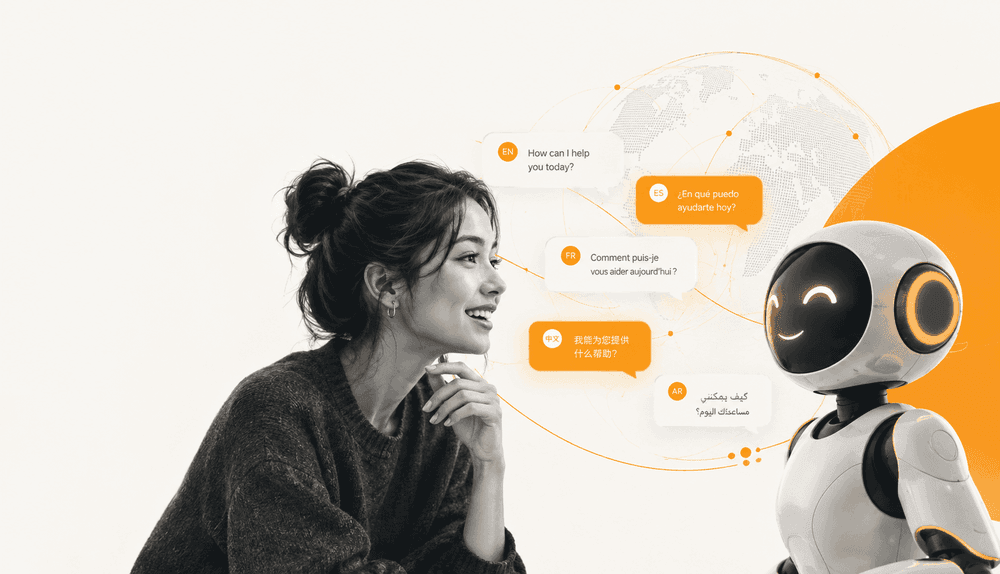
CSA Research surveyed nearly 9,000 consumers across 29 countries and found that 76% prefer to buy products with information in their own language. 40% said they will not buy at all from a website that only speaks a language they don't.
Most businesses have already invested in AI customer service and AI-powered customer support. Fewer have asked whether that support actually speaks the customer's language, or just translates a page after the fact. Multilingual AI chatbots are built to close exactly that gap.
Ignore it, and the cost shows up quietly. A customer in Jakarta or São Paulo doesn't file a complaint when your support only works in English. They just leave, and they buy from a competitor who met them in their own language instead.
This blog breaks down what multilingual AI chatbots actually do differently from translated support, a practical framework for deploying one, a real scenario showing the impact, and the mistakes that undercut the ROI most businesses expect from going multilingual.
What Multilingual AI Chatbots Actually Do for Global Customer Experience
A multilingual AI chatbot is not the same thing as a translated FAQ page or a browser plug-in that converts your English support script into Spanish, word for word.
A translation layer converts text. A multilingual AI chatbot understands intent, tone, and context in the customer's language, and responds the way a native speaker on your team would, not the way a literal translation would.
This distinction matters more than it sounds like it should. CSA Research also found that 75% of consumers are more likely to repurchase from a brand when customer care is available in their own language. That number holds even among customers who are comfortable reading English. Given the choice, people still default to their own language for anything that involves trust, money, or a problem that needs solving.
Because a translated homepage gets you a visitor. A multilingual conversation gets you a customer.
This is why an AI chatbot for global businesses needs to be built around real-time multilingual conversation, not a translation add-on stapled onto an English-first support stack. Global customer experience isn't a feature. It's the baseline expectation for any business selling outside its home market.
A Framework for Deploying an AI Chatbot for International Business
Rolling out multilingual support well takes more than switching on a language setting. Here's a practical sequence.
1. Audit where your customers actually are
Look at your support ticket data, sign-up locations, and payment currency, not just the languages your team assumes matter. Most businesses are surprised by how much support volume comes from a market they never formally entered.
2. Choose real-time capability over static translation
An AI chatbot for international customers needs to respond in the moment, not route the conversation through a translation queue. Real-time multilingual AI chatbots for business handle this without adding latency to the support experience.
3. Build in a clear human handoff
Not every conversation should stay with the bot. High-stakes issues, refunds, complaints, anything emotionally charged, should escalate to a human fluent in that language. The chatbot's job is to handle volume and route what it shouldn't handle alone.
4. Localize tone, not just vocabulary
Multilingual customer service that reads as stiff or literally translated damages trust faster than no translation at all. Tone, formality, and phrasing need to match cultural expectations in each market, not just swap out words.
5. Track outcomes by region
Measure global customer support the same way you'd measure any other growth channel: resolution time by language, CSAT by region, ticket deflection rate, and repeat purchase rate among customers served in their own language.
What This Looks Like in Practice
Consider a mid-stage SaaS company expanding from a single English-speaking market into Latin America and Southeast Asia.
Before: Support ran through a small English-speaking team, with occasional help from a bilingual contractor. Response times for non-English tickets stretched past 24 hours. Regional CSAT scores sat well below the company's home-market average, and churn in the new markets was nearly double what leadership expected.
After: The company deployed multilingual customer support through an AI chatbot handling first response in the customer's language, with human agents stepping in for complex cases. Response time for non-English tickets dropped to minutes. Regional CSAT closed the gap with the home market within two quarters, and support cost per ticket fell, since the same team could now handle volume across multiple languages instead of routing everything through one bottleneck.
This is close to the problem Omnio, our real-time multilingual interpretation platform, was built to solve: making conversations, not just static content, work across languages without the delay of manual translation during meetings and conferences.
Common Mistakes to Avoid
Multilingual AI chatbots fail to deliver ROI when businesses treat the rollout as a checkbox instead of a strategy.
- Confusing translation with localization: A grammatically correct sentence that ignores tone or cultural context still reads as foreign to the customer receiving it.
- No escalation path: A chatbot with no route to a human for sensitive cases erodes trust exactly when it matters most.
- One tone across every market: The same chatbot personality doesn't land the same way in every culture. What reads as friendly in one market can read as unprofessional in another.
- Measuring deployment instead of outcomes: "The chatbot supports 12 languages" is not a result. Resolution time, CSAT, and repeat purchase rate by region are.
- Rolling out everywhere at once: Prioritizing markets based on actual ticket volume and revenue potential beats trying to support every language simultaneously from day one.
Language Is a Growth Lever, Not a Support Detail
Multilingual AI chatbots don't just reduce support costs. They remove the single most common reason an international customer quietly disappears: not being understood.
For founders already using AI somewhere in the business, extending it to the part of the business that talks directly to global customers is one of the more measurable ways to turn AI for global business growth into actual revenue, not just efficiency.
The businesses winning in new markets right now aren't the ones with the most translated content. They're the ones whose customers never had to think about which language they were being served in.
Curious what multilingual, real-time support could look like for your business?
Talk to acAIberry about how Omnio and our AI consulting practice can help you build support that grows with your global customers, not around them.
Why Are Multilingual AI Chatbots Important for Global Business Growth?
Going global means more than translating your website. Learn why multilingual AI chatbots are becoming essential for businesses expanding globally and how real-time, localized customer support can improve customer experience, reduce support costs, and support international growth.