
Workflow Redesign: The Missing Piece in Enterprise AI ROI
Most enterprise AI pilots improve individual tasks but fail to create measurable business impact. The missing piece is often workflow redesign, not better AI tools.
A 2025 MIT study on generative AI adoption found that 95% of enterprise AI pilots deliver no measurable impact on the P&L, despite an estimated $30 to $40 billion in enterprise investment. Task-level speed goes up. Dashboards show adoption. The bottom line does not move.
This is the Enterprise AI ROI Gap, and it is not a data problem, a model problem, or a talent problem. It is a structural one. Most companies are adding AI to workflows that were never designed to use it.
Left unaddressed, this gap compounds. Budgets get clawed back at the next planning cycle. Internal teams start treating "AI project" as a synonym for "expensive experiment." Meanwhile, the handful of companies that redesigned their processes around AI, instead of layering it on top, pull ahead on cost structure and speed to market.
This blog breaks down where the ROI actually leaks, gives you a practical framework for fixing it, walks through a realistic example, and flags the mistakes that keep most pilots stuck.
Why Task Automation Isn't the Same as ROI
There is a meaningful difference between Task Automation vs Value Chain Re-architecture, and most enterprise AI budgets get spent on the former while expecting results from the latter.
Task automation takes one step in an existing process, usually a well-defined, repetitive one, and makes it faster with AI. Drafting an email. Summarizing a call. Tagging a support ticket. These are real time savings for the person doing the task.
But a workflow is a chain. If you speed up one link and leave the rest of the chain untouched, the process still moves at the speed of its slowest, least-changed part. The bottleneck just relocates. Approvals still wait on the same manager. Data still gets re-entered into three systems by hand. The decision that used to take three days still takes three days, because the decision-maker and the decision process never changed.
This is the core mechanic behind the ROI gap:
Placing a jet engine on a wooden cart won't give you an airplane. It just breaks the cart. You cannot fix your P&L by speeding up isolated tasks inside a legacy system.
The fix is not a faster task. It is Workflow Redesign for Generative AI: rebuilding the process itself around what AI actually changes, which is not how fast a single step runs, but which steps need to exist at all, who or what owns each decision, and where information should move automatically instead of being handed off.
A Framework for Redesigning the Workflow, Not the Task
Before selecting a tool or a vendor, founders need a process for identifying where redesign actually creates value. Here is a working framework.
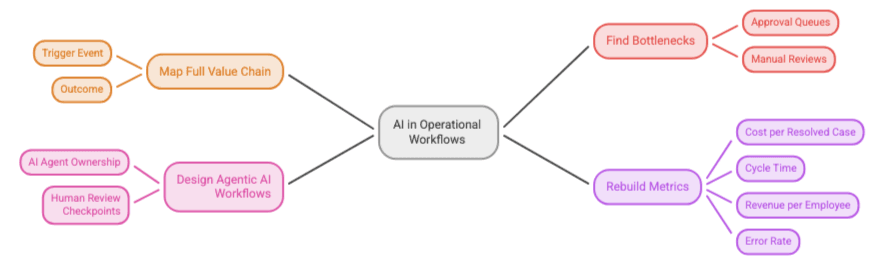
1. Map the full value chain, not the task
Start from the outcome your business is paid for, not the task someone complained about. Trace every step, system, and handoff between the trigger event and the outcome. Most teams have never mapped this end to end.
2. Find where decisions and handoffs actually live
The real bottlenecks are rarely the tasks themselves. They are the approval queues, the manual reviews, the moments where information sits in someone's inbox waiting for a decision. Automating the task next to the bottleneck does nothing. You have to redesign around the bottleneck itself.
3. Design for Agentic AI Operational Workflows
Instead of deploying AI to complete one task and hand it back to a human for the next ten steps, design workflows where an AI agent owns a full segment of the process end to end, with clear checkpoints for human review at the points that actually carry risk. This is the shift from Agentic AI Operational Workflows replacing fragments of a process to owning outcomes within defined boundaries.
4. Rebuild the metric before you rebuild the process
If your success metric is "hours saved" or "adoption rate," you will optimize for the wrong thing. Tie every redesign to a P&L-relevant number: cost per resolved case, cycle time from lead to close, revenue per employee, error rate at handoff. If a redesign does not move one of these, it is not done yet.
What This Looks Like in Practice
Consider a mid-stage SaaS company handling inbound sales inquiries.
Before redesign: A rep manually reads each inbound lead, drafts a qualifying email using an AI writing tool, and manually updates the CRM. The AI tool saves the rep roughly ten minutes per email. Lead response time barely changes, because qualification still waits for the rep's queue, and CRM data still lags by a day because updates happen in batches at the end of the shift.
After redesign: The workflow is rebuilt so an AI agent ingests the lead, scores it against qualification criteria, drafts a tailored response, and updates the CRM in real time. A human reviews only leads that score above a defined deal-size threshold or trigger a compliance flag. Every other qualified lead moves straight to a booked call.
The task, drafting an email, barely changed. What changed was who owns the decision to qualify a lead and when the data updates. Response time dropped from days to minutes. CRM data became reliable enough to forecast against. That is where the P&L impact shows up, not in the speed of the email draft.
Where Enterprise AI Pilots Go Wrong
Understanding Why Enterprise AI Pilots Fail to Scale means looking at a consistent set of avoidable mistakes.
- Automating the loudest complaint instead of the highest-leverage step. The task people complain about most is rarely the one holding back the P&L.
- No clear owner for the redesigned process. If accountability for the new workflow isn't assigned to a specific person or team, the pilot quietly reverts to the old process within a quarter.
- Measuring usage instead of outcomes. High login numbers and positive survey feedback do not equal revenue impact or cost reduction.
- Treating a successful pilot as proof of scale readiness. A workflow that works for one team of five people often breaks when the data volume, edge cases, and stakeholder count triple.
- Skipping change management for the humans still in the loop. If the people whose jobs touch the new workflow were not involved in redesigning it, they will find ways to route around it.
The Real Fix Isn't More AI. It's a Different Workflow.
The enterprise AI ROI gap is not a sign that the technology underdelivers. It is a sign that most organizations are optimizing the wrong layer of the process. Speed at the task level and value at the P&L level are two different problems, and only one of them gets solved by adding a better model.
Founders who close this gap are not the ones with the most AI tools deployed. They are the ones willing to question the shape of the process itself before deciding where AI fits into it.
That question, asked early, is worth more than any single AI feature you could add later.
Ready to find out where your workflow is actually losing ROI?
Talk to acAIberry about auditing and redesigning your AI-powered workflows for measurable, P&L-level impact.
Workflow Redesign: The Missing Piece in Enterprise AI ROI
Most enterprise AI pilots improve individual tasks but fail to create measurable business impact. The missing piece is often workflow redesign, not better AI tools.