
Inclusion Starts at the Microphone
Why speaking in your first language matters at multilingual events, what research shows, and how Omnio supports speakers and listeners across languages.
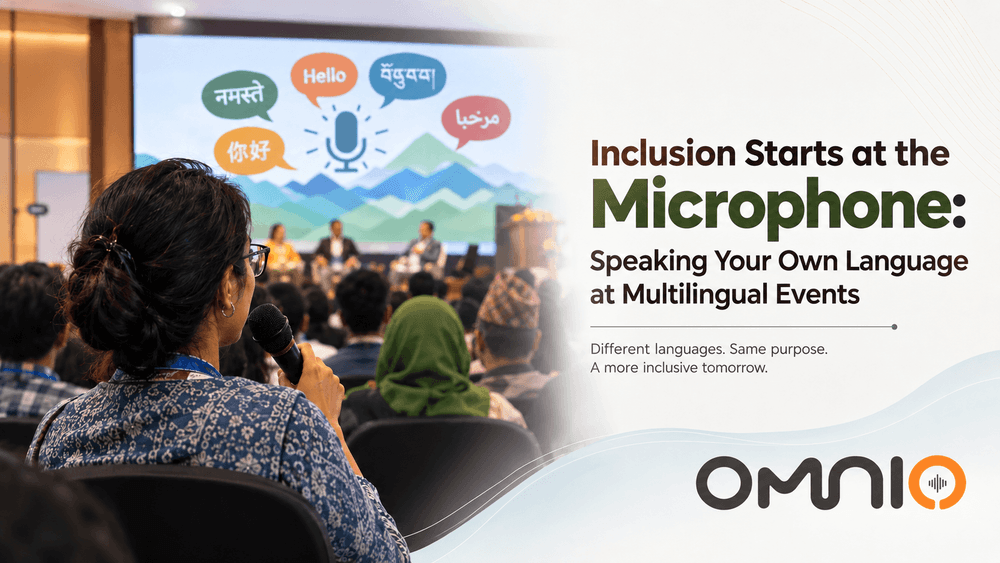
Most multilingual events are built so people can listen in their own language. Fewer are built so people can speak in it. Research on second-language speech suggests that gap costs speakers credibility and voice, and it is the gap Omnio is designed to narrow.
In August 2026, around 400 people met in Mongolia for the Global Pastoralist Gathering and Conference. About 240 were international delegates from 102 countries. Another 100 were Mongolian pastoralists, whose grazing land and livelihoods were the subject of the week. The sessions moved from plenary halls in Ulaanbaatar to field visits and household meetings in the provinces and ended with three declarations adopted for presentation at UNCCD COP17. Our team ran Omnio, our real-time translation platform, throughout (how Omnio was used at the Global Pastoralist Gathering).
When the people most affected by a decision are in the room, can they say what they mean in the words they would choose, or must they first translate their thinking into someone else's language?
Many international events now handle listening reasonably well. Interpretation channels, captions and translated slides all serve the audience. Much less design effort goes into the person who stands up to speak.
What changes when you speak in a second language
Speaking a language you learned later is not simply a slower version of speaking your own. A few well-known studies hint at what changes.
The first concerns credibility. In a 2010 University of Chicago experiment, listeners rated scripted trivia statements as slightly less likely to be true when a speaker with a foreign accent read them. The researchers' explanation was effort rather than prejudice: listeners mistook the work of understanding the speech for doubt about the claim. When listeners were told the study was about accents, the penalty disappeared for mild accents but remained for heavy ones (ScienceDaily on Lev-Ari and Keysar). The effect was small and measured in a lab, but meetings are full of small effects that decide whose point gets picked up.
The second concerns status. Tsedal Neeley studied a French technology company that made English its working language. Non-native speakers reported a loss of status whatever their actual fluency, and responded in different ways, including holding back from interaction (Organization Science, 2013). Many people who have chaired an international meeting will recognise the capable delegate who goes quiet.
The third concerns feeling. Boaz Keysar and colleagues found in 2012 that people making identical choices in a second language showed weaker framing effects and less aversion to losses (BPS Research Digest). The authors were unsure why and suggested a foreign language adds emotional distance. The study measured decisions, not speeches, so any link to how people argue is our inference. Still, if a second language cools the speaker's own sense of what is at stake, it is reasonable to expect some of that urgency to drop out of what they say.
Listening access is only half of inclusion
Typical interpretation planning starts from the audience: which languages do delegates need to receive? Whether someone can contribute in their language is often decided by default. If it is not one of the staffed booth languages, the speaker either stays silent or performs in English.
We think a multilingual event deserves a harder test. Could a participant have spoken in the language they think in and still been understood by the room? We have argued before that participation matters more than comprehension. This piece looks at the speaker's side of that idea.
How Omnio supports the person at the microphone
Omnio is a cloud-hosted platform that combines speech recognition, machine translation and speech synthesis in one pipeline. Our team brought it from Nepal to Mongolia for the pastoralist gathering. From the speaker's side, a session runs like this.
A panellist begins speaking into a podium or handheld microphone, which feeds the event's audio mixer and then Omnio. They do not announce or select a language, because Omnio's automatic language detection identifies it. A presenter who would rather speak in their first language, among those Omnio supports for speech input, can do so without any change to the setup.
In the audience, each participant opens a mobile-first web app on their own phone, with nothing to download from an app store and no receiver headset to collect. They choose the language they want to follow. At the Mongolia gathering the catalogue offered 189 languages. They hear translated audio and can read live captions alongside it.
When someone in the audience wants to respond, they use the "Ask a Question" feature to request the floor from the app. A moderator approves the request, so the chair keeps control of turn-taking and the person asking does not have to compete for the chair's attention. If the roaming microphone they are handed is routed through the same audio setup as the podium, their words reach Omnio too.
Organisers switch session modes as the programme changes, from plenary keynote to Q&A panel, breakout session or informal discussion. Afterwards they can download a full transcript, a usage report and the original audio recording. For a declaration drafted across several languages, that record is worth keeping.
What AI translation does not solve
Machine translation still makes mistakes with specialised terms, strong dialects, crosstalk and poor audio. Treaty text, legal testimony and other high-stakes wording still need professional interpreters and careful review.
There is also a tension with the argument above. If tone and urgency matter, a synthesised voice will carry less of both than the speaker's own. Organisers can soften this by keeping the original audio audible in the room, encouraging listeners to use captions alongside translated audio, and asking chairs to pause briefly so translation can catch up before replies begin.
The case for AI translation is coverage rather than perfection. Human interpretation is excellent in the languages an event can staff and absent from the rest. Omnio can extend access to languages that would otherwise get none.
Five ways to design for speakers
If you organise multilingual meetings, a few decisions shift the balance towards the people at the microphone:
- Tell participants, in the opening session and in writing, which languages they may speak in, and test those languages with real speakers before the event.
- Brief chairs to invite contributions in other languages and to leave a short pause for translation.
- Route every microphone in the room, including roaming handhelds, through the same audio setup as the podium.
- Use moderated floor requests so quieter participants have a way in that does not depend on catching the chair's eye.
- Review the transcript afterwards to see whose contributions actually reached the record.
The pastoralists in Mongolia were discussing land their families depend on. Decisions like that deserve to be argued in the language people use to think about them, and an event's language setup can make that possible or quietly rule it out.
Planning a multilingual conference, workshop or summit? Talk to our team about a live Omnio demonstration, or see how Omnio works for your speakers, sessions and languages.
Inclusion Starts at the Microphone
Why speaking in your first language matters at multilingual events, what research shows, and how Omnio supports speakers and listeners across languages.